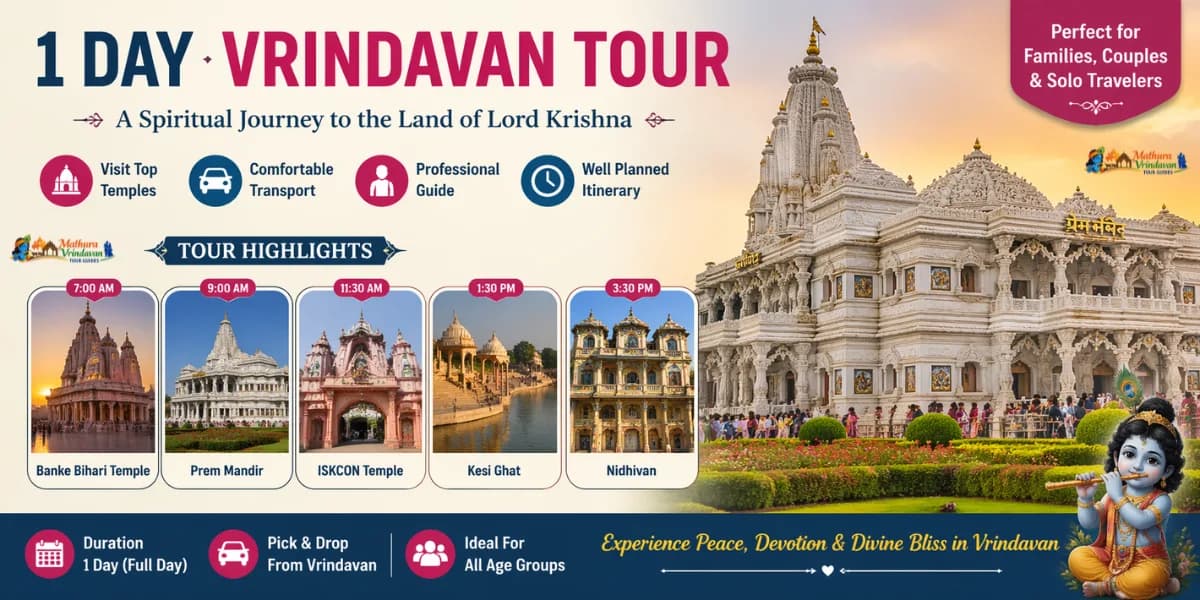
Vrindavan Parikrama is the sacred 10 km circumambulation of Vrindavan city — one of the most meritorious acts a pilgrim can perform in Braj. Walk clockwise through 15+ sacred temples and ghats, chanting Radhe Radhe. Most powerful on Ekadashi and during Kartik month. Free to do. Takes 2.5–4 hours.
Distance
~10 km
Full outer circuit
Duration
2.5–4 hrs
With darshan stops
Direction
Clockwise
Always Pradakshina
Sacred Sites
15+
Temples & ghats
Best Day
Ekadashi
Twice monthly
Entry Fee
Free
Public sacred route
Quick Answer — Vrindavan Parikrama
Total Distance
~10 km
Full circumambulation of Vrindavan
Time Required
2.5–4 hours
On foot, with darshan stops
Best Day
Ekadashi (twice monthly)
Most spiritually meritorious
Best Season
Kartik Month (Oct–Nov)
Holiest month in Vrindavan
Direction
Clockwise (Pradakshina)
Always walk clockwise
Starting Point
Keshi Ghat (traditional)
Or any major temple
Footwear
Barefoot most meritorious
Footwear also accepted
Entry Fee
Free — public route
All ghats & outer route free
Water & Snacks
Carry from start
Limited shops on outer route
Best Start Time
4:30–6 AM (pre-dawn)
Coolest, most peaceful time
From Mathura Jn
12 km / 25 min taxi
₹300–450 to Vrindavan
Guide Recommended
For first-time visitors
Know all landmarks + shortcuts
The Padma Purana states that performing Vrindavan Parikrama is equal in spiritual merit to visiting all pilgrimage sites (tirtha-kshetras) in India. This is an extraordinary statement — and explains why millions of devotees from across the world walk this route each year.
Vrindavan is not merely a historical city — in the Gaudiya Vaishnava tradition, it is the eternal abode of Radha and Krishna, where their divine play (leela) continues without interruption. To walk around this sacred land is to acknowledge the divinity embedded in every grain of its soil.
The parikrama is a moving meditation — 10 km of walking becomes a direct encounter with Radha-Krishna's presence when each step is accompanied by their names.
The Padma Purana, Skanda Purana and Braj Bhakti Vilas all describe the immense merit of Vrindavan Parikrama. The Six Goswamis of Vrindavan — the greatest Vaishnava scholars of the 16th century — personally performed and advocated this parikrama.
Every particle of Vrindavan soil is sacred according to Vaishnava tradition. Walking barefoot allows direct contact with this sacred earth. Many saints have wept while doing parikrama, overwhelmed by the sacredness of walking where Radha and Krishna walked.
Doing parikrama on Ekadashi (the 11th lunar day) multiplies the spiritual benefit manifold. Thousands of fasting devotees walk together in darkness before dawn — the collective devotional energy on Ekadashi nights is one of the most powerful experiences in Braj.
During Kartik month (October–November), daily parikrama is considered the highest form of spiritual practice. Deep Daan (lamp offering) at Keshi Ghat after completing the Kartik parikrama is the traditional completion of the most auspicious month in Vrindavan.
All 14 major stops in clockwise order from Keshi Ghat
| Km | Sacred Site | Significance | Darshan Timing |
|---|---|---|---|
| 0 | Keshi Ghat | Traditional starting point — where Krishna slew Keshi demon. Sacred Yamuna bath before parikrama. | Aarti 6:00–7:00 PM |
| ~0.5 | Cheer Ghat | Site of Krishna's Cheer-harana leela — where he stole the gopis' clothes. Ancient Kadamba tree. | Open all day |
| ~1 | Kaliya Ghat | Where Krishna danced on the Kaliya serpent — one of the most powerful leela sites in Vrindavan. | Open all day |
| ~1.5 | Imli Tala Ghat | Ancient tamarind tree where Krishna played his flute for the gopis. Deeply meditative spot. | Open all day |
| ~2 | Pani Ghat / Madan Mohan | Traditional gopi water-carrying ghat. Adjacent Madan Mohan Temple (est. 1542) by Sanatana Goswami. | Temple: 6AM–12PM, 5–8PM |
| ~3 | Govind Dev Temple | One of the most important temples of the Six Goswamis — built 1590. Radha Govinda deity. | 5:30AM–12PM, 5–9PM |
| ~4 | Radha Damodar Temple | Where Srila Prabhupada lived before founding ISKCON. Jiva Goswami samadhi. Historical centre of Gaudiya. | 6AM–12PM, 5–8PM |
| ~5 | Banke Bihari Temple | Most beloved temple in Vrindavan — the spiritual heart of the city. Unique parda (curtain) darshan. | 7:45AM–12PM, 5:30–9PM |
| ~5.5 | Radha Raman Temple | Self-manifested deity (1542). Unbroken puja tradition for 480+ years by hereditary Goswami priests. | 6AM–12PM, 5–9PM |
| ~6 | Nidhivan / Seva Kunj | Sacred grove — site of Krishna's nightly Raas Leela with Radha. Closes at sunset. Deeply mystical. | 8AM–sunset (closes early) |
| ~7 | ISKCON Krishna Balram | International temple with Gaura-Nitai, Krishna-Balaram, Radha-Shyamasundar deities. World-class complex. | 4:30AM–1PM, 4–8:30PM |
| ~8 | Prem Mandir | Marble temple complex (2012) with elaborate gardens and evening light show at 7:15 PM. 84 leela tableaux. | 5:30AM–12PM, 4:30–8:30PM |
| ~9 | Pagal Baba Ashram | Famous ashram near Keshi Ghat area. Landmark for returning parikrama — almost back to start. | Open all day |
| ~10 | Keshi Ghat (completion) | Return to starting point. Evening Yamuna Aarti at 6:00–7:00 PM is the perfect parikrama completion ritual. | Aarti daily 6–7 PM |
Traditional starting point — where Krishna slew Keshi demon. Sacred Yamuna bath before parikrama.
Aarti 6:00–7:00 PM
Site of Krishna's Cheer-harana leela — where he stole the gopis' clothes. Ancient Kadamba tree.
Open all day
Where Krishna danced on the Kaliya serpent — one of the most powerful leela sites in Vrindavan.
Open all day
Ancient tamarind tree where Krishna played his flute for the gopis. Deeply meditative spot.
Open all day
Traditional gopi water-carrying ghat. Adjacent Madan Mohan Temple (est. 1542) by Sanatana Goswami.
Temple: 6AM–12PM, 5–8PM
One of the most important temples of the Six Goswamis — built 1590. Radha Govinda deity.
5:30AM–12PM, 5–9PM
Where Srila Prabhupada lived before founding ISKCON. Jiva Goswami samadhi. Historical centre of Gaudiya.
6AM–12PM, 5–8PM
Most beloved temple in Vrindavan — the spiritual heart of the city. Unique parda (curtain) darshan.
7:45AM–12PM, 5:30–9PM
Self-manifested deity (1542). Unbroken puja tradition for 480+ years by hereditary Goswami priests.
6AM–12PM, 5–9PM
Sacred grove — site of Krishna's nightly Raas Leela with Radha. Closes at sunset. Deeply mystical.
8AM–sunset (closes early)
International temple with Gaura-Nitai, Krishna-Balaram, Radha-Shyamasundar deities. World-class complex.
4:30AM–1PM, 4–8:30PM
Marble temple complex (2012) with elaborate gardens and evening light show at 7:15 PM. 84 leela tableaux.
5:30AM–12PM, 4:30–8:30PM
Famous ashram near Keshi Ghat area. Landmark for returning parikrama — almost back to start.
Open all day
Return to starting point. Evening Yamuna Aarti at 6:00–7:00 PM is the perfect parikrama completion ritual.
Aarti daily 6–7 PM
* Distances approximate. Outer Parikrama Marg ~10 km · Inner city route ~8–8.5 km.
Arrive at Keshi Ghat. Take a sacred bath in the Yamuna or perform achamana (purification). Offer a handful of Yamuna water to the sun. Begin with a prayer to Krishna and Radha, stating your intention (sankalp) to complete the Vrindavan Parikrama.
Begin walking in a clockwise direction (Pradakshina). This is the sacred direction for circumambulation in the Hindu tradition. Follow the Parikrama Marg — the outer ring road of Vrindavan. Most sections have clear signage.
Walk at a steady, comfortable pace. Traditional parikrama is done while chanting Hare Krishna Mahamantra or Radhe Radhe with each step. The purpose is not physical exercise but meditation and devotion. There is no rush.
At each major temple and leela site along the route, briefly stop for darshan and recollection of the associated story. You do not need to enter every temple — a moment of reverent acknowledgment is sufficient to receive the benefit.
The parikrama is complete when you return to your starting point. A complete circuit without stopping or shortcuts receives the full spiritual benefit. If you must rest, rest — but do not deviate from the clockwise direction.
Return to Keshi Ghat (or your starting temple) and offer final prayers. If time permits, attend the Keshi Ghat Yamuna Aarti at 6:00–7:00 PM — completing the parikrama with the evening aarti is a deeply moving experience.
| Period | Significance | Crowd Level | Temperature | What's Special |
|---|---|---|---|---|
| Kartik Month (Oct–Nov) | ★★★★★ MOST SACRED | Very High | 15–28°C | Deep Daan daily, Dev Deepawali, all temples decorated |
| Ekadashi (twice monthly) | ★★★★★ MOST MERITORIOUS | High | Seasonal | Thousands do parikrama on Ekadashi — extraordinary energy |
| Janmashtami Week (Aug) | ★★★★★ MOST FESTIVE | Extreme | 30–36°C | Entire city celebrations — intense spiritual atmosphere |
| October–March | ★★★★☆ BEST WEATHER | Moderate–High | 8–28°C | Pleasant for full parikrama — ideal conditions |
| November–February | ★★★★☆ WINTER SWEET SPOT | Moderate | 8–22°C | Cool, clear mornings — best photography conditions |
| April–June | ★★☆☆☆ CHALLENGING | Low | 35–45°C | Very hot — only early morning (4:30–7 AM) is manageable |
| July–September (Monsoon) | ★★★☆☆ LUSH BUT WET | Moderate | 28–36°C | Jhulan Yatra, Janmashtami — beautiful but heavy rain possible |
Deep Daan daily, Dev Deepawali, all temples decorated
Thousands do parikrama on Ekadashi — extraordinary energy
Entire city celebrations — intense spiritual atmosphere
Pleasant for full parikrama — ideal conditions
Cool, clear mornings — best photography conditions
Very hot — only early morning (4:30–7 AM) is manageable
Jhulan Yatra, Janmashtami — beautiful but heavy rain possible
Pre-dawn start (4:30–5 AM) is the most spiritually powerful and also the coolest part of the day. Thousands of devotees walk in darkness chanting Hare Krishna — the atmosphere is extraordinary.
Walking barefoot is most meritorious but the route has both paved and unpaved sections. Comfortable flat sandals are practical for first-timers. The inner city lanes have more uneven surfaces than the outer Parikrama Marg.
Carry at least 1 litre of water per person. The outer Parikrama Marg has limited shops. In summer, carry 2 litres. Coconut water is available at some points along the route.
The Parikrama Marg (outer ring road) is the traditional route. The inner city lanes offer a shorter but more crowded alternative through the market. First-timers should follow the outer ring road.
A local guide for the parikrama is invaluable — they know every sacred story at every site, can identify shortcuts if needed, and ensure you don't miss any key landmarks. Our guides have walked this route hundreds of times.
Traditional parikrama is done while chanting. The most common practice is japa (repetition of God's names on a mala bead). Even silent mental chanting transforms the walk from exercise to meditation.
The outer Parikrama Marg is generally not crowded except on Ekadashi and festival days. The inner lanes of Vrindavan (near Banke Bihari) can be very crowded from 9 AM onwards. Plan your temple stops accordingly.
On Ekadashi, thousands of devotees do the parikrama. The atmosphere is extraordinary but the route is busy. For a full Ekadashi parikrama experience, arrive by 4 AM. The pre-dawn procession of devotees walking in darkness with chanting is one of the most powerful experiences in Braj.
Summer Parikrama Warning
Vrindavan summer (May–June) reaches 40–45°C. Parikrama in full sun between 9 AM–5 PM is dangerous. If visiting in summer, restrict parikrama to 4:30–7 AM only. Carry 2 litres of water. Heatstroke risk is real.
Mathura Vrindavan Tour Guides
Know every sacred story at every stop. Our guides have walked the parikrama hundreds of times and bring it alive with the Bhagavata Purana and Braj tradition narratives.
Parikrama Guide
Full route narration
Vrindavan Taxi
Station to start point
1-Day Tour
Parikrama + temples
Ekadashi Package
Book ahead
Why book a guide for Vrindavan Parikrama?
13 real questions people ask about Vrindavan Parikrama
Vrindavan Parikrama is the sacred circumambulation of the entire city of Vrindavan — walking around the outer boundary of this holy city in a clockwise direction while chanting the names of Radha and Krishna. The complete circuit is approximately 10 km and passes through or near all major sacred sites in Vrindavan. It is one of the most meritorious acts a pilgrim can perform in Braj.
The Vrindavan Parikrama route is approximately 10 km in total circumference. The inner route (through the city lanes) is slightly shorter at 8–8.5 km. The outer Parikrama Marg (ring road) is the traditional and more complete route at approximately 10 km. The distance passes through all sacred zones of Vrindavan.
A complete Vrindavan Parikrama on foot takes approximately 2.5–4 hours depending on walking pace and how many temples you stop at. Walking at a comfortable devotional pace with brief darshan stops at major sites: 3–3.5 hours. A brisk walk without stops: 2 hours. An extended parikrama with proper darshan at each temple: 4–5 hours.
The most spiritually meritorious time for Vrindavan Parikrama is: (1) Kartik month (October–November) — the holiest month in Vrindavan, especially for parikrama. (2) Ekadashi (the 11th lunar day, occurring twice monthly) — the most sacred day for parikrama in the Vaishnava tradition. (3) Pre-dawn start (4:30–6 AM) — the Brahma Muhurta is considered the most auspicious time of day for devotional practice. October–March is also the best season for weather.
Vrindavan Parikrama must always be done in a clockwise direction (Pradakshina). This is the sacred direction for all circumambulations in the Hindu tradition — the deity or sacred city is kept on your right as you walk. Walking counter-clockwise is considered inauspicious and should be avoided.
Yes — walking Vrindavan Parikrama barefoot is considered most meritorious. Touching the sacred Vrindavan soil with bare feet is spiritually significant. However, the route includes both smooth paved sections and rough unpaved paths. For first-time visitors or those with health concerns, comfortable flat sandals are perfectly acceptable. Both are seen regularly.
The traditional starting point for Vrindavan Parikrama is Keshi Ghat on the Yamuna riverbank. The parikrama begins with a sacred bath in the Yamuna. However, you can technically start the parikrama from any point on the route — ISKCON, Banke Bihari Temple, or Prem Mandir are also popular starting points. What matters is completing the full 10 km circuit clockwise.
Ekadashi Parikrama refers to the sacred walk done specifically on Ekadashi (the 11th lunar day, occurring twice monthly). On Ekadashi, thousands of devotees — many fasting for the day — walk the complete Vrindavan Parikrama, often starting before dawn in the early hours. The spiritual energy of thousands of fasting, chanting devotees walking together in the darkness is considered one of the most powerful devotional experiences available in Braj. Nirjala Ekadashi (June) and Prabodhini Ekadashi (November) see the largest turnout.
Key temples on the Vrindavan Parikrama route (in order): Keshi Ghat → Cheer Ghat → Kaliya Ghat → Imli Tala Ghat → Pani Ghat / Madan Mohan Temple → Govind Dev Temple → Radha Damodar Temple → Banke Bihari Temple → Radha Raman Temple → Nidhivan / Seva Kunj → ISKCON Krishna Balram Mandir → Prem Mandir → return to Keshi Ghat. Each site has its own sacred story from the Bhagavata Purana and Braj tradition.
Yes, with proper planning. The Parikrama Marg (outer route) is mostly flat with paved sections, making it manageable for elderly devotees at a slow pace. Recommendations: start very early morning (coolest time), take frequent breaks, carry water, hire an e-rickshaw for the long flat sections if needed, and engage a local guide who knows all rest points. Many elderly devotees complete the full parikrama — some take 5–6 hours with rest breaks.
According to the Padma Purana and Braj Bhakti Vilas, performing Vrindavan Parikrama is equal in merit to visiting all pilgrimage sites (tirtha-kshetras) in India. The parikrama is a moving meditation — you are literally circumambulating the sacred land where Radha and Krishna performed their eternal divine play (leelas). Every grain of soil in Vrindavan is sacred according to the Vaishnava tradition. The parikrama is an act of reverence to the land itself.
A vehicle parikrama (going around Vrindavan by e-rickshaw, auto or car) is possible and done by those who cannot walk the full distance. However, the traditional and most meritorious parikrama is done on foot. The walking parikrama allows you to stop at each sacred site, feel the sacred soil underfoot, and maintain the meditative pace that gives the parikrama its spiritual purpose. If health prevents walking, even a partial walk with vehicle transport for the rest is considered valid.
Keshi Ghat (traditional starting point) is easily reached from: Mathura Junction station — taxi to Vrindavan (12 km, 25 min, ₹300–450), then e-rickshaw to Keshi Ghat (₹30–50). From Delhi: train to Mathura Junction (2 hrs) then taxi. From ISKCON Vrindavan: 2 km walk or 5 min e-rickshaw to Keshi Ghat (₹40). Our guide service includes pickup from Mathura Junction and transport to the parikrama starting point.
Discover Mathura Vrindavan – the divine land of Shri Krishna with peaceful darshan, expert local guides, and comfortable travel experiences.
Rated by 38,000+ devotees
With over 19 years of local expertise in Mathura and Vrindavan, we have served more than 38,000 happy devotees. Our 4.8/5 average rating reflects our commitment to providing authentic, comfortable, and memorable spiritual journeys in the sacred Braj region.
“Darshan is the essence of our yatra.”
Guides born and raised in Braj, not outsiders.
Every tour is designed around temple darshan and spiritual experience.
No hidden fees — clear, upfront pricing for all services.
Well-maintained vehicles with trusted drivers for safe travel.
Your spiritual journey is our top priority — we serve with devotion.
Always available to assist you before, during and after your tour.
We treat every yatra as a sacred seva, not just a tour package.
Guides born and raised in Braj, not outsiders.
Every tour is designed around temple darshan and spiritual experience.
No hidden fees — clear, upfront pricing for all services.
Well-maintained vehicles with trusted drivers for safe travel.
Your spiritual journey is our top priority — we serve with devotion.
Always available to assist you before, during and after your tour.
We treat every yatra as a sacred seva, not just a tour package.